The Mud Pit
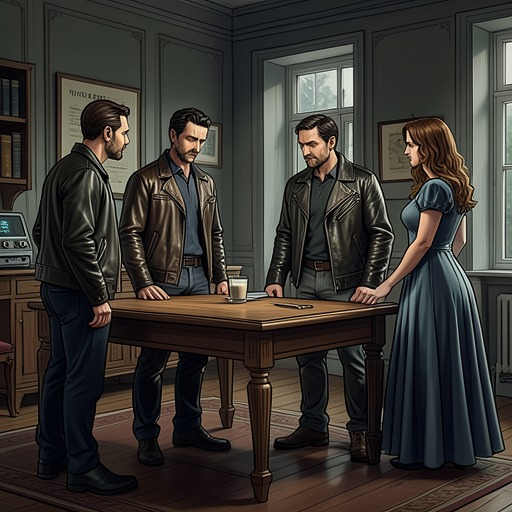
Gang Up: A Bikerland NovelThe Mud Pit is the Family’s bar in Temple and one of the clearest social crossroads in the wasteland. Open to outsiders with money but governed by the Family’s violence, it turns drinking, trade, mourning, and political rivalry into a single public theater. Its importance lies in how quickly ordinary sociability can become factional pressure: the bar is a place where power is announced, loyalties are measured, and the instability following Titus’s death can be felt before it becomes open war.
Setting and Function
The Mud Pit operates inside the Family’s Compound, a fortified settlement made from squat concrete buildings reinforced with steel and layered with lead against the world’s continuing radiation. Unlike the protected spaces reserved for the Family and its closest Kin, the bar admits traders and other outsiders who can pay. They spend their money on the Family’s prostitutes and moonshine, but payment offers no real security. Anyone who is not Family, or who fails to provide regular money, risks being present in a place where death is common and fights are even more common.
That combination makes the bar both business and instrument of rule. The Family supplies drink, sex, and access, while retaining the power to decide who may remain and who may survive a dispute. The Mud Pit therefore reflects the wider order of the Compound: hospitality is conditional, commerce is backed by force, and public space belongs to the group that controls it.
Titus’s Death and the Succession Crisis
The bar becomes especially charged after Titus is killed. His funeral brings the Family, Kin, and Temple’s citizens together at the cemetery he founded on a hill outside town, but the Mud Pit is where the political consequences of his death settle into everyday conversation. The old King is dead, and the question is who will be crowned in his place. The heat of the postwar wastes surrounds the gathering, while the overcrowded cemetery embodies the exhaustion of the order Titus established.
Inside the Mud Pit, stories and bravado circulate among veterans, older riders, and younger men associated with Case. Talk of Brall and the Cauldron is not merely entertainment; it rehearses the loyalties that will matter in the coming conflict. The Family’s men are divided between Case and Troy, Titus’s former second-in-command, while the uneasy peace with the Cauldron rests on the fact that neither side has yet shed blood. The bar thus serves as an informal political chamber before any formal consolidation of power has occurred.
Case enters by ordering another round for everyone, putting the entire night on his account. The gesture produces an immediate cheer and displays generosity as authority: he can purchase the room’s mood, at least temporarily, and make the crowd respond to him. Yet the celebration is shadowed by suspicion. Troy and Sandra sit at opposite ends of the bar, each blaming the other for Titus’s murder, which occurred in the open street without witnesses. In Temple, the absence of witnesses is itself suspicious, suggesting that those who knew the truth were paid off, loyal, or dead. The Mud Pit makes that uncertainty communal, turning private accusation into a public atmosphere.
Grief, Friendship, and Faction
Robin experiences the bar differently from the men using it as a political gathering. A cloud of grief hangs over the Mud Pit, but she wants no part of the shared mourning because she already lives inside grief herself; everyone else’s sadness makes the public display feel false to her. The crowded room offers noise and company without understanding. Abigail remains Robin’s best friend, although Robin considers Abigail’s advice unreliable, and the bar becomes the setting in which Robin’s isolation is placed beside the Family’s collective performance of strength.
The women’s position within this space is also governed by the Family’s gender hierarchy. Sandra keeps the girls in line, demanding that they look attractive, smile, and avoid answering back while riders are away protecting the settlement. The Mud Pit’s commercial traffic makes that hierarchy visible: outsiders arrive to spend money on the Family’s women and drink, while the Family decides the terms under which everyone participates. Abigail’s refusal to conform distinguishes her from Robin and irritates Sandra, even though Titus had favored Abigail and treated her like a son.
The bar’s social function extends beyond the Compound’s immediate factional struggle. Elsewhere, crowds may gather at the walls and be driven away by armed guards, but the Mud Pit provides a controlled point of contact between the Family and those who depend on it. Its apparent openness is therefore part of the Compound’s authority. People may enter, trade, listen, and drink, yet the possibility of sudden violence remains the constant condition of their access.
From Public Gathering to Wider Conflict
The Mud Pit belongs to the same narrative world as the major collective confrontations that follow. The story repeatedly places political decisions, denunciations, and sexualized displays before assembled groups, and the bar is an early version of that public arena. Its crowd absorbs speeches, rumors, cheers, and accusations; later gatherings make those same mechanisms more explicit when Sandra publicly speaks against Troy before the men and townspeople, and when Family and Cauldron members participate in a peace ceremony watched by their respective groups.
The contrast is important. In the Mud Pit, social energy remains unstable: conversation sinks into a somber rumble, cheers can be purchased, and rival leaders sit apart while preparing for conflict. In later mass scenes, collective attention is deliberately organized around a speaker, a denunciation, or a ritual claim. The bar is the rough, improvised form of the same political technology. It shows how community is manufactured through shared presence even when the people gathered together do not share trust.
Its vulnerability is finally underscored by the violence directed at the Family’s Compound. An enormous explosion erupts from the south side, striking the wall and setting the surrounding structure into a tower of flame. The question of who remains inside turns the fortified settlement’s promise of safety into immediate danger. Although the explosion is not confined to the Mud Pit, it threatens the protected social world that the bar represents: commerce, drinking, factional talk, and Family authority can all be consumed when the walls fail.
Narrative Significance
The Mud Pit is more than a background tavern. It is a compressed model of Temple’s dual social order, where the Family’s power is exercised through both welcome and intimidation. Traders enter because the bar offers goods and services; Family members gather because it offers familiarity and status; rivals use it because public proximity makes avoidance impossible. Every interaction carries the possibility of a transaction, a test of allegiance, or a fight.
As a location, it gives the succession crisis a physical voice. Titus’s death is remembered at the cemetery, but the struggle to inherit his authority is heard in the bar’s rumors, silences, and sudden cheers. Case’s paid round shows his attempt to command the room through largesse, while Troy and Sandra’s separation shows that the Family’s leadership is already fractured. Robin’s grief reveals the emotional cost concealed beneath the crowd’s rituals. The Mud Pit therefore stands at the threshold between the old Family order and the violent new ways approaching Temple: a place still open for business while the entire political world around it is preparing to burn.